


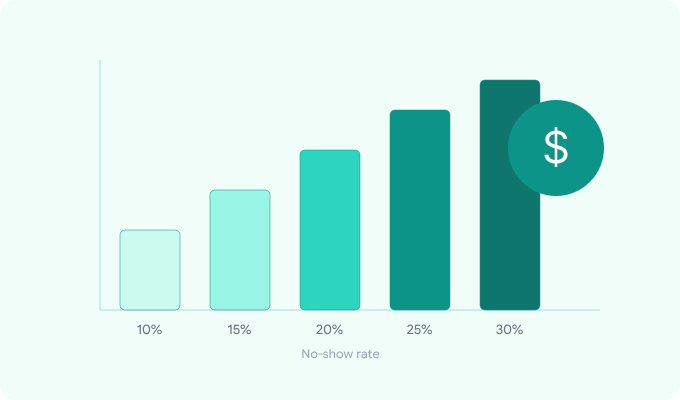
The Real Cost of No-Shows to Your Practice (And How to Measure It)
Slug: real-cost-of-no-shows-medical-practice
Most practices underestimate how much no-shows are actually costing them. Here's how to calculate the true revenue impact, and what to do about it.
Ask a practice manager how much no-shows cost their practice and you'll usually get one of two answers: a rough gut estimate, or a shrug. Very few practices have actually sat down and done the math. Those that have are almost always surprised by what they find.
The sticker shock isn't because no-shows are a new problem. Everyone knows they're expensive. It's because the true cost compounds in ways that aren't obvious until you look at the numbers carefully. The missed appointment is just the starting point.
The direct cost: the easy part
The most straightforward component of no-show cost is the revenue that didn't come in because the appointment didn't happen. The math is simple:
No-shows per week × average appointment value × 52 = annual direct revenue loss
For a practice seeing 150 patients per week with a 20% no-show rate and an average appointment value of $180:
- No-shows per week: 30
- Annual direct revenue loss: 30 × $180 × 52 = $280,800
That number alone tends to get attention. But it's actually the floor, not the ceiling.
The indirect costs: what most practices miss
Provider time that can't be recovered. When a patient no-shows, the provider's time for that slot is gone. Unlike a retail business that can simply serve fewer customers during a slow period, a medical practice has fixed provider capacity. Every empty slot is a provider being paid to see no one. Depending on how your practice accounts for provider compensation, this cost may not appear in your no-show calculation at all, but it's real.
Staff time spent on manual follow-up. Calling to confirm appointments, chasing down no-shows, attempting to rebook cancelled slots: these tasks add up to hours of front desk time every week. If your staff is spending two hours a day on appointment-related manual work, that's roughly 500 hours a year of labor cost that could be redirected to higher-value tasks, or eliminated through automation.
Downstream appointment loss. A patient who no-shows once is statistically more likely to no-show again. A patient who no-shows repeatedly is often a patient who has disengaged from their care, and may eventually leave the practice entirely. The lifetime value of a patient relationship is difficult to quantify precisely, but losing patients to disengagement is a meaningful long-term cost that never shows up in a no-show report.
Care continuity costs. This one is harder to put a dollar figure on but matters for how practices think about the problem. When patients miss appointments, particularly follow-up visits, chronic disease management appointments, or post-procedure checks, their health outcomes can deteriorate. That may mean emergency visits, hospitalizations, or complications that end up costing the healthcare system more downstream. For value-based care arrangements, these outcomes can have direct financial implications for the practice.
How to measure your actual no-show rate
Before you can address the cost, you need an accurate picture of your current rate. This sounds obvious, but many practices are working from estimates rather than data.
Your practice management system almost certainly tracks this. The question is whether you're pulling the report regularly and whether the definitions are consistent. A few things to nail down:
Define your terms. A "no-show" is a patient who doesn't appear and doesn't call. A "late cancellation" is a patient who cancels inside your cancellation window. A "cancellation" is a patient who cancels with sufficient notice. These are different problems with different solutions, and lumping them together obscures what's actually happening.
Track by provider, by day, and by appointment type. Aggregate no-show rates hide patterns. A practice with an 18% overall rate might have one provider running at 8% and another at 28%. Monday mornings might run 30% while Thursday afternoons run 10%. New patient appointments might no-show at twice the rate of established patients. The patterns tell you where to focus.
Measure over time. A single week's data is noise. A rolling 90-day view starts to show signal. Track the rate monthly and compare it quarter over quarter to understand whether the problem is stable, growing, or improving.
Building a complete cost picture
Once you have accurate rate data, you can build a more complete cost model. Here's a framework:
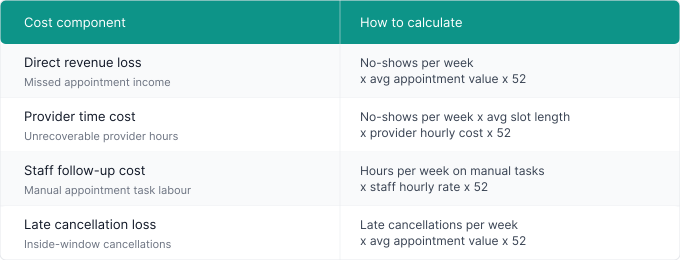
Adding these together gives you a number that is almost always higher than what practices expect, and a much stronger business case for investing in tools that reduce it.
What a realistic improvement looks like
No intervention eliminates no-shows entirely. The goal is meaningful, measurable reduction, and the tools available today make that achievable without adding staff workload.
Practices that implement automated multi-channel reminders typically see no-show rate reductions in the range of 20 to 35%. A practice running at 20% might come down to 13 to 16%, a meaningful shift that translates directly to recovered revenue.
Adding a card-on-file policy on top of reminders compounds the effect. The combination of a reminder that makes showing up easy and a policy that makes not showing up costly addresses the problem from both directions.
Automated rebooking captures a portion of the revenue that cancellations would otherwise take with them, turning some of the remaining loss into recovered slots.
None of these interventions is a silver bullet. But together, applied consistently through the right infrastructure, they can move the needle on a cost that most practices have simply accepted as a fixed feature of running a medical practice.
It isn't fixed. It's measurable. And that means it's solvable.