


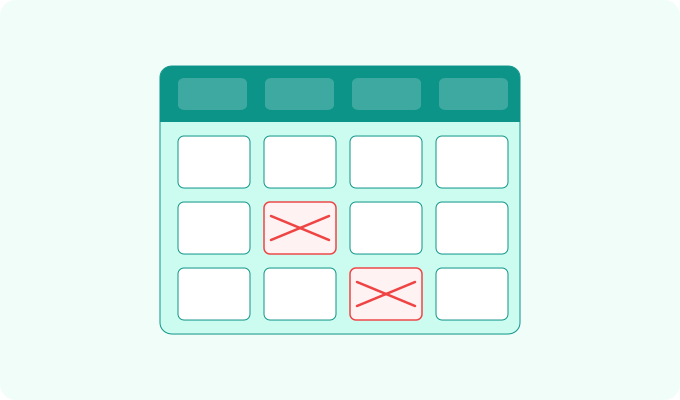
No-show rates in medical practices typically run between 15% and 30%. For a busy practice seeing 150 patients a week, that's anywhere from 22 to 45 missed appointments every single week. Multiplied across a year, the revenue loss is significant. But the cost isn't just financial. Every empty slot is a patient who didn't get care, and a provider whose time went to waste.
Understanding why patients miss appointments is the first step toward reducing them. The reasons are more predictable than most practices realize, and so are the solutions.
The most common reasons patients no-show
They forgot.This is the single most common reason, and the most preventable. Life is busy, appointments are often booked weeks in advance, and without a timely reminder, many patients simply lose track. Studies consistently show that reminder-based interventions reduce no-show rates by 20-30%.
They couldn't get time off work. Many patients book appointments with the best intentions, then find themselves unable to leave work when the day arrives. This is especially common for mid-day appointments and for practices that don't offer early morning or evening availability.
Transportation fell through. For elderly patients, patients with disabilities, and patients in rural or underserved areas, getting to a clinic is genuinely difficult. A cancelled ride or an unexpected transportation barrier can turn a confirmed appointment into a no-show with no advance notice.
They felt better, or worse. Patients who book during a health concern sometimes feel their symptoms resolve before the appointment date and decide not to bother going. Others who are genuinely unwell on the day of their appointment may be too sick to travel but unsure how to cancel.
The booking friction was too high. Some patients don't show up because cancelling felt harder than just not appearing. If your practice has a complex phone-based cancellation process or no easy way to reschedule, some patients will take the path of least resistance and simply disappear.
Financial anxiety. Patients who are uncertain about costs, copays, or what their insurance covers sometimes avoid appointments rather than face an unexpected bill. This is more common than practices realize, and it's rarely communicated directly.
What practices can do about it
Send reminders at the right time and through the right channel. A reminder sent two weeks before an appointment has limited value. The sweet spot for most practices is a reminder at 72 hours and again at 24 hours before the visit. Text messages consistently outperform email for appointment reminders because they're read faster and responded to more reliably. The reminder should include a simple one-tap confirmation link so your team knows who's coming without making any calls.
Make it easy to cancel and reschedule.Counter-intuitively, making cancellation easy reduces your overall no-show rate. When patients can cancel or reschedule with a single tap from a reminder message, they do, and you get the slot back with enough time to fill it. When cancellation is difficult, patients default to silence.
Automate your rebooking workflow.A cancelled appointment isn't necessarily lost revenue; it's an open slot. The practices that recover the most revenue from cancellations are those with an automated process for filling the gap: reaching out to a waitlist, surfacing the opening to other patients, or notifying the front desk in real time. Manual processes move too slowly to fill slots reliably.
Keep a payment method on file.A card-on-file policy, where patients provide a payment method at booking that can be charged for late cancellations or no-shows, reduces no-show abuse without requiring difficult front-desk conversations. When patients know there's a financial consequence for no-showing, they're more likely to either show up or give advance notice. The key is communicating the policy clearly at the time of booking, so there are no surprises.
Identify your highest-risk patients.Not all no-shows are equally predictable. Patients who have no-showed before are significantly more likely to do so again. New patients, patients with long gaps since their last visit, and patients booked far in advance all carry higher no-show risk. Practices that identify these patterns early, and apply more proactive outreach to high-risk bookings, see meaningful reductions in their overall rate.
Look at your scheduling patterns. Some no-show patterns are structural. Monday morning appointments, Friday afternoon slots, and mid-day bookings on weekdays tend to see higher no-show rates across most practice types. If your data shows clustering in specific time windows, it may be worth adjusting how you fill those slots or applying extra confirmation steps to bookings in those windows.
The infrastructure problem
Most practices know what they should be doing. The challenge is execution. Sending reminders manually, tracking confirmations in a spreadsheet, calling patients to rebook cancelled slots, and managing card-on-file authorizations are all tasks that make sense in isolation, but together they represent hours of front desk work every week that most practices simply don't have capacity for.
The practices that consistently maintain low no-show rates aren't necessarily doing anything conceptually different from everyone else. They've built or adopted infrastructure that handles these tasks automatically, so reminders go out on schedule, rebooking workflows trigger without staff intervention, and card-on-file policies are enforced without awkward conversations.
No-shows are a measurable problem. That means they're a solvable one.